Avalanche usually gets summed up as a fast, EVM-compatible blockchain. True enough, but it undersells the project. Avalanche is closer to a framework for running many blockchains around a single validator economy, and its consensus protocol works differently from both Bitcoin's and Ethereum's.
We'll start with what Avalanche is, where it came from and what it is used for today. Then we'll look under the hood at its consensus, its chains and the AVAX token, and at what staking AVAX now involves since the Helicon upgrade of September 2026.
Where Avalanche comes from
On May 16, 2018, a pseudonymous group calling itself Team Rocket published a paper on IPFS titled Snowflake to Avalanche: A Novel Metastable Consensus Protocol Family for Cryptocurrencies. It proposed a new way for a network of machines to agree on a single history, without Bitcoin's mining race or the heavy voting rounds of classical distributed systems.
The ideas were developed further at Cornell University by Emin Gün Sirer, an associate professor of computer science and co-director of the Initiative for Cryptocurrencies and Contracts (IC3), with PhD students Maofan Yin and Kevin Sekniqi. Sirer was already known in crypto research. With Ittay Eyal, he had co-authored the "selfish mining" paper, which showed that Bitcoin miners controlling only a minority of the hash power could earn more than their fair share by strategically withholding blocks. A revised version of the Avalanche paper, Scalable and Probabilistic Leaderless BFT Consensus through Metastability, followed in June 2019, signed by Team Rocket, Yin, Sekniqi, Robbert van Renesse and Sirer.
Sirer and his two students then formed Ava Labs to turn the protocol into a production network. The public AVAX token sale in July 2020 raised $42 million in under five hours, and the network launched on September 21, 2020. Today, Avalanche is developed by Ava Labs and supported by the Avalanche Foundation, a non-profit that funds the growth of its ecosystem.
One platform, many blockchains
Most blockchains are a single chain that every application shares. Avalanche is built as a platform for running many blockchains side by side.
At its base sits the Primary Network. It includes the C-Chain, the Ethereum-compatible chain where most wallets, DeFi applications and tokens live. Around it, any company or community can launch its own blockchain, called an Avalanche L1 (formerly a subnet), with its own rules, its own validators and even its own fee token, while staying connected to the rest of the network.
This is Avalanche's core bet. Rather than having every application compete for space on one shared chain, it lets each application that needs its own environment run a dedicated chain.
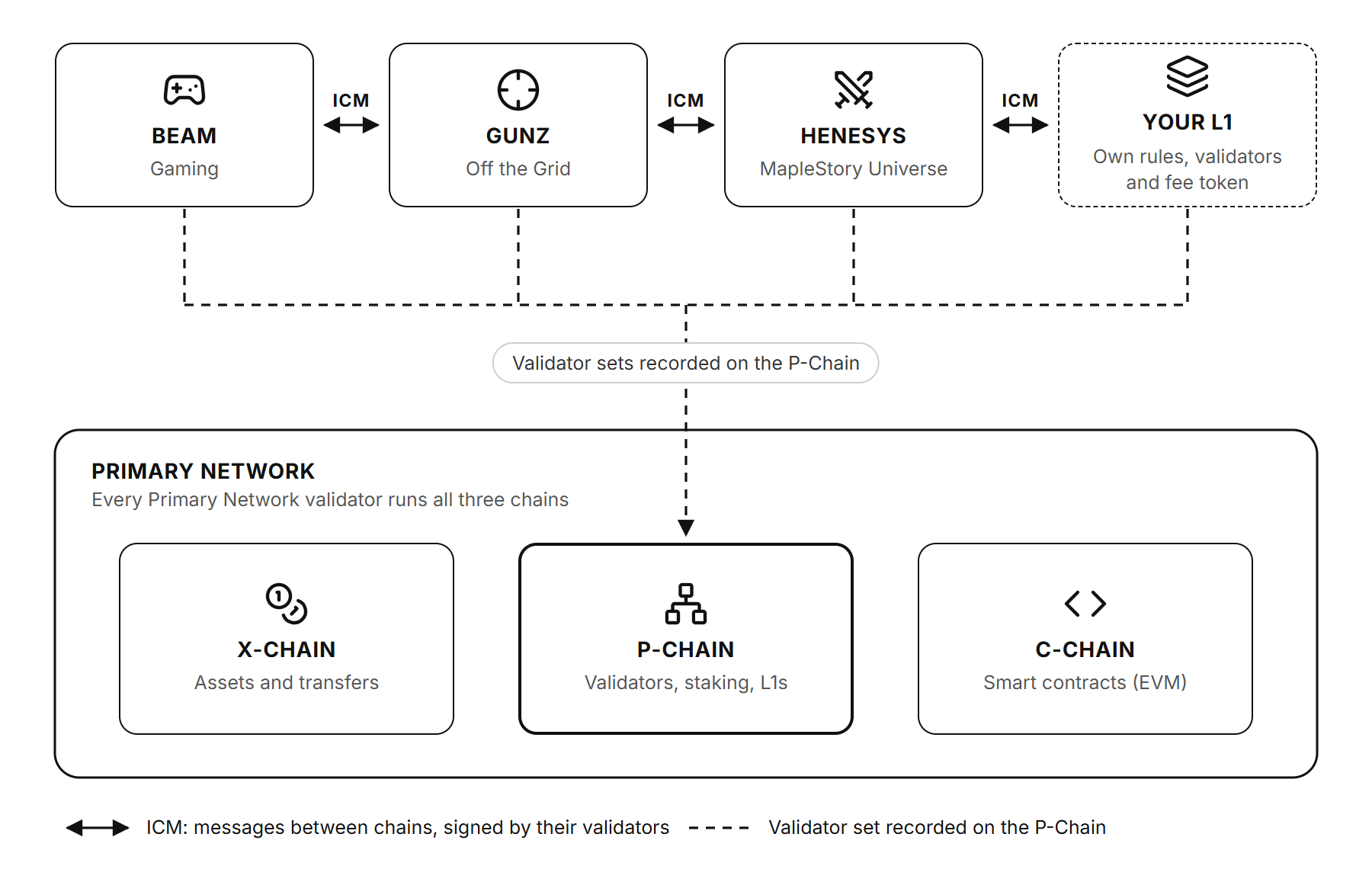
The Primary Network at the base, Avalanche L1s around it. Each L1 runs its own validators, recorded on the P-Chain. The ICM arrows are illustrative. They show that L1s can exchange messages through Interchain Messaging, not actual links between these chains.
What Avalanche is used for today
Gaming has been the most visible use of Avalanche L1s. Beam, GUNZ (the network behind the shooter Off the Grid) and Nexon's MapleStory Universe, which runs on its own L1, Henesys, all run on Avalanche, and in May 2025 FIFA announced an Avalanche L1 for its FIFA Collect platform.
Avalanche has also carved out a clear niche in tokenized finance. BlackRock's tokenized money market fund BUIDL has been available on Avalanche since November 2024, alongside Apollo's ACRED credit fund, tokenized by Securitize. In January 2026, Galaxy closed its first collateralized loan obligation, tokenized on Avalanche, with about $75 million financed at its initial closing. Wyoming's state-issued stablecoin, FRNT, which opened to the public in January 2026, is available on Avalanche among other chains. A 2026 research note from Charles Schwab described Avalanche as a leader in custom blockchains, while warning that this activity may not translate into demand for the AVAX token itself.
The token has also become easier to hold through traditional channels. VanEck listed an Avalanche ETF, VAVX, on Nasdaq on January 26, 2026, offering exposure to AVAX and to potential staking rewards.
A few numbers to size the ecosystem:
- $565 million in DeFi total value locked on Avalanche (DefiLlama, October 23, 2026).
- $1.28 billion in stablecoins on Avalanche (DefiLlama, October 23, 2026).
- About 2.5 million C-Chain transactions a day on average in Q2 2026 (Nansen).
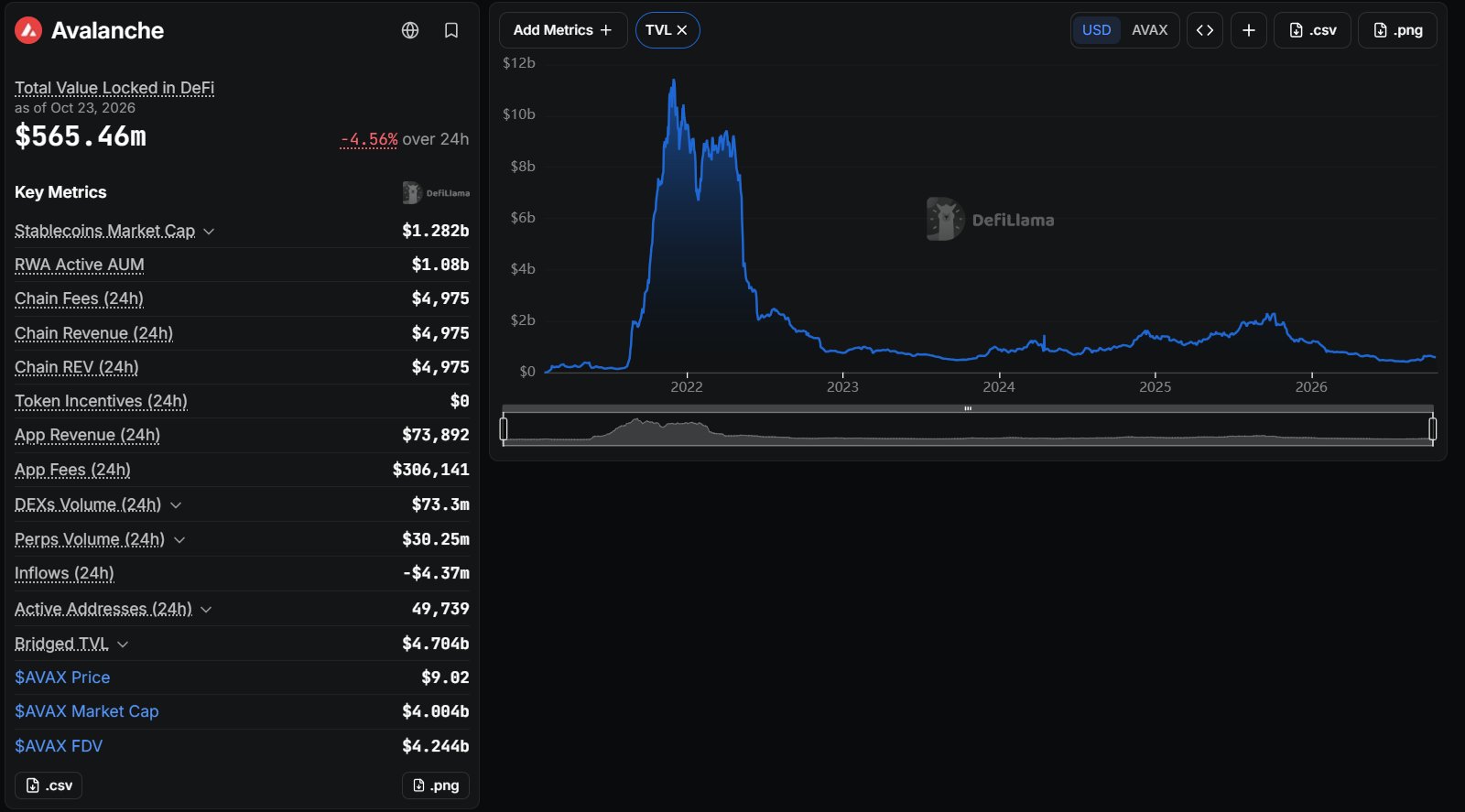
Total value locked in DeFi on Avalanche since 2021, with the chain's key metrics. Source: DefiLlama, accessed October 23, 2026.
To understand how the network supports all of this, it helps to start with the part that gave Avalanche its name.
How Avalanche reaches consensus
Every blockchain has to answer the same question. How do thousands of machines that do not trust each other agree on one history? Before Avalanche, there were two main families of answers, and each came with a cost.
Classical consensus, the BFT family behind many proof-of-stake chains, works through voting rounds in which validators exchange messages with one another. It produces fast, final answers, but the messaging load climbs as the validator set grows, which pushes these networks toward a limited number of validators.
Nakamoto consensus, the model behind Bitcoin, scales to any number of participants. But finality is probabilistic and slow, since you wait for blocks to pile up on top of yours, and security is paid for in energy.
Avalanche's answer is sampling. Instead of hearing from everyone, each validator repeatedly asks a small, random sample of other validators which of two conflicting options they prefer, and moves toward whatever a large majority of that sample answers. With AvalancheGo's default parameters, a node polls k = 20 validators per round, a round counts when at least α = 15 of them agree, and the decision is final once β = 20 consecutive rounds have confirmed the same choice. Samples are weighted by stake, which is what makes the system proof of stake. To sway the polls, you would need to control a large share of all staked AVAX.
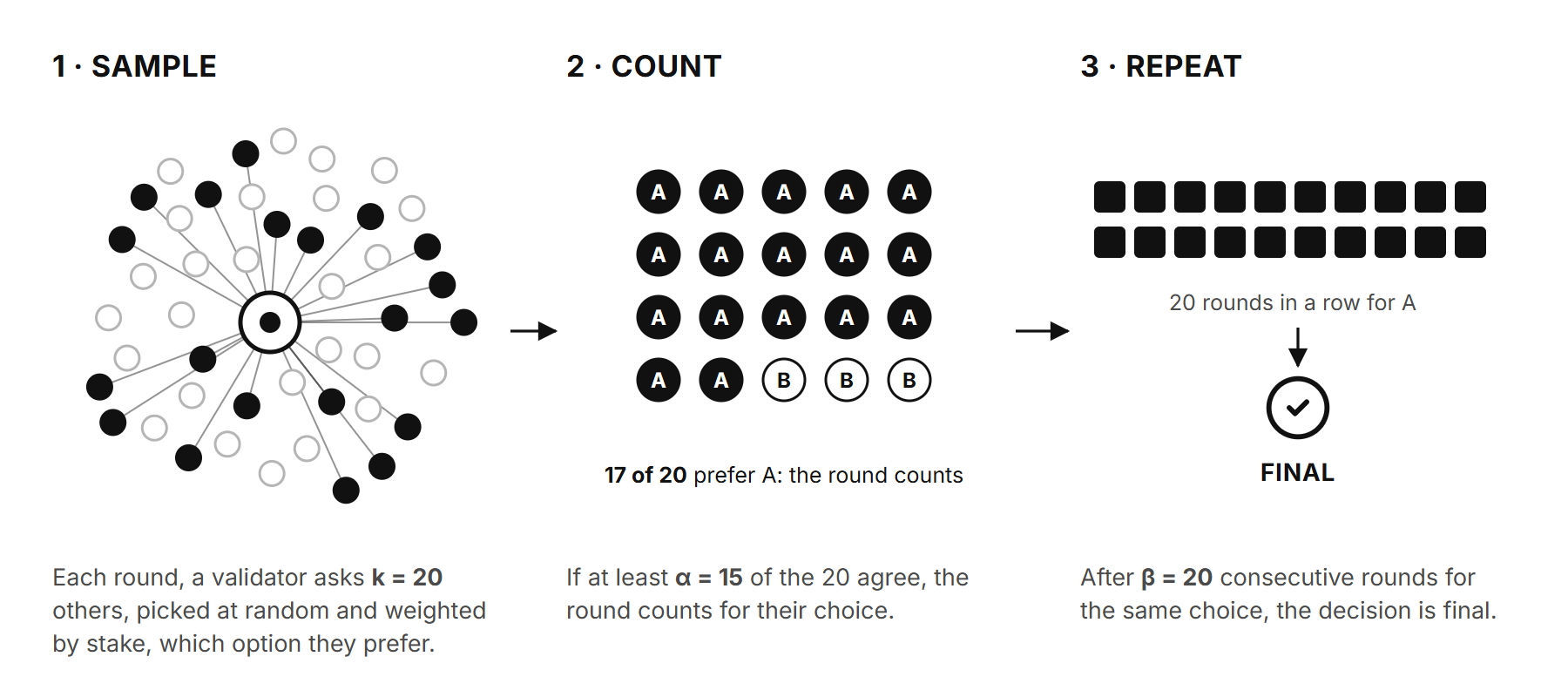
One decision, seen from a single validator, with AvalancheGo's default parameters.
The name carries the intuition. Like snow on a slope, the network starts balanced, and any small imbalance gets amplified round after round until every node tips the same way. Agreement does not depend on a leader coordinating each round, which is what the papers mean by "leaderless." And because every node only ever talks to a fixed-size sample, its workload per decision stays roughly constant however large the network grows. Avalanche's documentation puts acceptance latency at about one second.
The protocol family evolved in steps: Slush, Snowflake, Snowball, then Avalanche itself, which orders transactions in a DAG. Snowman is the variant for linear chains, and it is what all of Avalanche's main chains run today. The X-Chain, the last one built on a DAG, was "linearized" in the 2023 Cortina upgrade.
How the network is organized
The Primary Network is itself a special Avalanche L1, and it runs three chains, each with its own job. Every Primary Network validator validates all three.
| Chain | What it does | Model |
|---|---|---|
| X-Chain (Exchange) | Creating and transferring assets | UTXO, like Bitcoin |
| P-Chain (Platform) | Validators, staking, rewards, and the creation of L1s | Avalanche's Platform VM |
| C-Chain (Contract) | Smart contracts: wallets, DeFi and most applications | EVM, compatible with Ethereum tooling |
Most users only ever see the C-Chain. It is an EVM chain (chain ID 43114), so MetaMask, Solidity and the usual Ethereum tooling work as they are. Since Helicon, it also separates agreeing on blocks from executing them ("continuous execution," ACP-194), so the network can accept new blocks while earlier ones are still being executed, instead of pausing at every step.
The P-Chain is the one stakers care about. It is the registry of who validates what, for how long and with how much stake, and it is the chain that pays out staking rewards. Moving AVAX between chains is a native export and import, which wallets handle for you. AVAX has to be on the P-Chain before it can be staked.
How Avalanche L1s work
An Avalanche L1 plugs into the P-Chain, which records its validator set, and can run any virtual machine its builders choose. For years, though, the model came with a catch: every subnet validator also had to validate the Primary Network, which meant staking at least 2,000 AVAX.
That changed with Avalanche9000, whose technical core, the Etna upgrade, activated on December 16, 2024. Under ACP-77, L1 validators no longer validate the Primary Network or stake AVAX on it. Instead, they pay a continuous fee to the P-Chain. At the parameters set at activation, that is 512 nAVAX per second, about 1.33 AVAX per validator per month, as long as the number of fee-paying L1 validators stays at or below 10,000.
L1s talk to each other through Avalanche Interchain Messaging (ICM). A message is signed by the validators of the sending chain, their signatures aggregated into one BLS signature, and the receiving chain verifies it against that validator set as recorded on the P-Chain. A relayer carries the message between chains but cannot alter it, because the receiving chain trusts the validators' aggregated signature rather than a bridge operator.
AVAX: what the token does
AVAX has three jobs.
- Paying fees. Every transaction on the Primary Network is paid in AVAX, and the fee is burned, not paid to anyone. On the C-Chain, that includes the priority fee, which on Ethereum would go to the block producer.
- Securing the network. Validators and delegators stake AVAX on the P-Chain, and consensus samples are weighted by that stake.
- Paying for L1 validators. Since Etna, the continuous fee L1 validators pay to the P-Chain is denominated in AVAX.
Supply is capped at 720 million AVAX. Half of that, 360 million, existed at genesis. The rest is minted gradually as staking rewards, through a formula that scales with the supply still left to mint, so issuance slows as the cap gets closer. As of October 23, 2026, the P-Chain reports a supply of about 475.7 million AVAX, an upper bound that does not net out burned fees.
One consequence matters for stakers. Since fees are burned, Avalanche validators do not earn transaction fees or tips. Their income is the protocol's staking rewards, plus the delegation fee they charge delegators. Rewards follow a published formula, not network activity.
Staking AVAX: validate or delegate
There are two ways to take part in Avalanche's proof of stake natively, both on the P-Chain.
Validating means running a node and staking at least 2,000 AVAX on it. Delegating means assigning at least 25 AVAX to an existing validator. The validator does the work, and you share in the rewards, minus the validator's delegation fee.
| Validator | Delegator | |
|---|---|---|
| Minimum stake | 2,000 AVAX | 25 AVAX |
| Minimum duration | 48 hours (two weeks before Helicon) | 2 weeks |
| Maximum duration | 1 year | 1 year, and within the validator's own period |
| Auto-renewal | Optional, since Helicon | No |
| Reward condition | At least 90% uptime over the period | The validator's uptime, same rule |
| Fee | Sets its delegation fee, minimum 2% | Pays the validator's fee |
| Early exit | Not possible | Not possible |
A validator's total weight, its own stake plus everything delegated to it, is capped at the lower of 3 million AVAX and five times its own stake. A validator staking 2,000 AVAX can therefore accept up to 8,000 AVAX of delegations in total.
As of October 23, 2026, the P-Chain lists 611 Primary Network validators. They hold 176.9 million AVAX of their own stake, and 39.5 million more is delegated to them across 38,673 delegations. That makes about 216 million AVAX staked in total, roughly half of the circulating supply (about 444 million AVAX, per CoinGecko).
Source: P-Chain platform.getCurrentValidators and platform.getCurrentSupply, queried
on October 23, 2026.
What Helicon changed
Helicon activated on Avalanche mainnet on September 22, 2026, with AvalancheGo v1.15.0. It bundles six Avalanche Community Proposals. Two of them reshape the C-Chain: continuous execution (ACP-194), covered above, and a minimum gas price that validators can adjust over time (ACP-283). The other four change staking:
- Shorter minimum for validators (ACP-273). The minimum validation period drops from two weeks to 48 hours. Delegations keep their two-week minimum, and the one-year maximum is unchanged.
- Auto-renewed staking (ACP-236). Instead of a fixed end date, a validator can set a cycle length and the share of each cycle's rewards to restake. At the end of each cycle, rewards are settled and the stake rolls into the next one, until the validator asks to stop and exits at the end of the current cycle. A validator that misses the uptime bar in a cycle is exited at the end of it. Auto-renewal is for validators only. A delegation must fit inside the validator's current cycle and never renews itself.
- Stricter uptime (ACP-267). The bar for rewards rises from 80% to 90% uptime, for every staking period that starts after activation. Periods that started earlier keep the 80% rule.
- Lower rewards for short stakes (ACP-285). The reward curve's floor, the minimum consumption rate, falls from 10% to 7.5% in a straight line over the 90 days following activation, so the ramp completes around December 21, 2026. Each stake keeps the rate in effect on the day it starts. The one-year rate is unchanged.
As a result, Avalanche now rewards long commitments noticeably more than short ones. ACP-285's own model shows the gap.
| Staking duration | Annual reward rate before | After the full ramp |
|---|---|---|
| 14 days | 5.36% | 4.08% |
| 90 days | 5.58% | 4.58% |
| 182 days | 5.85% | 5.18% |
| 365 days | 6.38% | 6.38% |
Projections from ACP-285, based on a supply of about 470.1 million AVAX. Rates also drift down as supply grows, and delegators receive them minus the validator's fee.
Operators are already using the new options. On October 23, 2026, 76 of the 611 validators were on auto-renewal (72 of them set to renew again), and 50 were running periods shorter than two weeks.
Where your AVAX actually is
This is where the non-custodial question comes back. On Avalanche, the split between the keys that run a validator and the keys that own the stake is built into the protocol.
A node holds two keys. Its staking key (staker.key) is the TLS key that gives the
node its NodeID. Its BLS signer key (signer.key) produces the signatures that get
aggregated for cross-chain messages (ICM), and its public key is registered on the P-Chain
when the validator is added. Both keys live on the operator's machine, and neither of them
can move funds. As the official docs put it, a validating node does not need to hold any
AVAX at all.
The stake itself is locked on the P-Chain by a transaction signed with the staker's own key. That transaction also records the reward address. When the period ends, the protocol returns the stake automatically to the owner set in the staking transaction, which should be your own address, and pays rewards to the reward address. No one has to approve it or claim it.
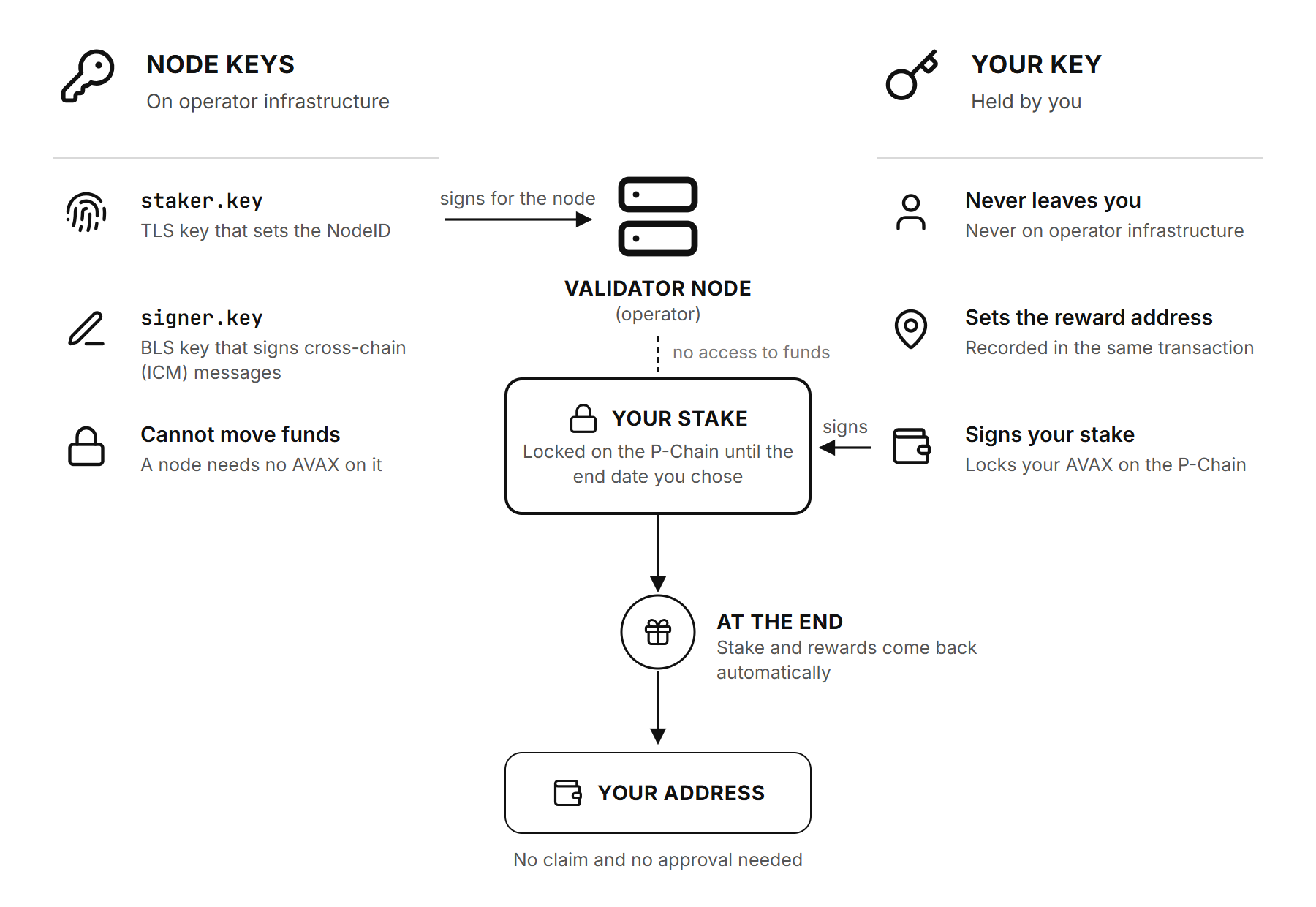
The node's keys run the validator. Your key locks the stake and decides where it goes back.
For a delegator, that means the validator you choose never touches your AVAX. It cannot move it, redirect it or keep it. If you fund a full validator that someone else operates, apply the same check: the reward addresses, and on an auto-renewed validator the key authorized to change its configuration, should be keys you control.
No slashing, but not no risk
Avalanche has no slashing. A validator that goes offline or misbehaves does not lose principal, and neither do its delegators. This is a real difference from networks like Ethereum, but it does not make staking AVAX risk-free. The risks lie elsewhere.
- Rewards are all-or-nothing. Uptime is judged per staking period, by a stake-weighted majority of the other validators. A validator that falls below 90% loses the whole period's rewards, and so do its delegators. There is no partial payout.
- Your stake is locked. There is no early exit on Avalanche. Once a stake is issued, its amount, duration and reward address cannot be changed until it ends (an auto-renewed validator can only change the length and restake share of its next cycle).
- Duration matters more than it used to. Since ACP-285, a short stake earns significantly less per year than a long one.
- Losing the node's keys has consequences. If the staking key is lost, the node gets a
new NodeID, which can jeopardize the validation reward. Operators need backups of
staker.key,staker.crtandsigner.key.
How to choose a validator
If you delegate, choosing the validator is the main decision you make. Check:
- Uptime history. The 90% threshold is a hard line. Look for a validator that has stayed comfortably above it across past periods, not one that clears it narrowly.
- The delegation fee. The protocol minimum is 2%, but validators set any value above that. On October 23, 2026, 273 validators charged the 2% minimum, and 135 charged 100%, meaning a delegator would receive nothing.
- The end date or cycle. Your delegation must end before the validator's current period or cycle does. A validator running two-day cycles cannot accept a two-week delegation at all.
- Remaining capacity. A validator that has reached five times its own stake, or 3 million AVAX, cannot take more delegations.
- The operator behind it. Infrastructure, monitoring and transparency are what keep uptime above 90% period after period.
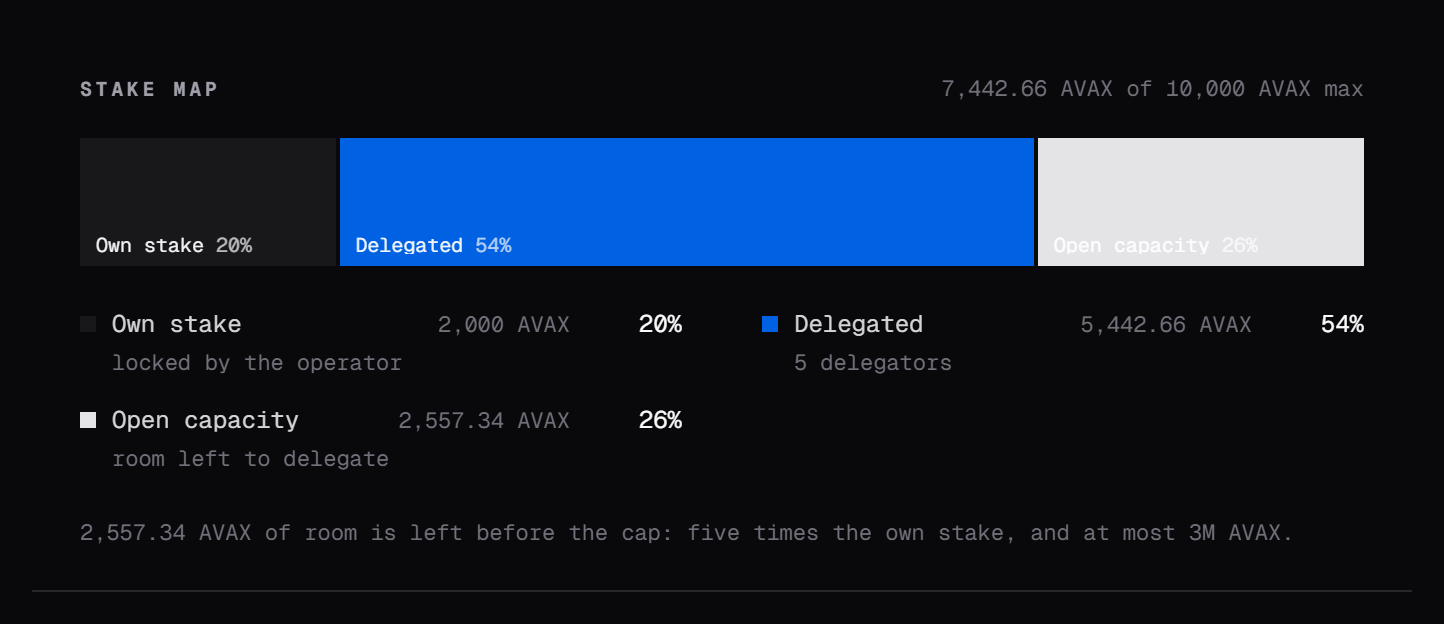
Our own validator's stake map, with 2,557 AVAX of room left before its 10,000 AVAX cap. Source: Avalanche explorer, accessed October 23, 2026.
Three ways to stake AVAX
The custody spectrum from our breakdown of non-custodial staking, Where Are Your Keys?, applies to Avalanche as it does elsewhere.
| Exchange staking | Liquid staking (e.g. sAVAX) | Native delegation | |
|---|---|---|---|
| Who holds the principal | The platform | A smart contract | You, locked on the P-Chain |
| Liquidity | Platform terms | A tradeable token | Locked until the period ends |
| Main trust assumption | The company's solvency | The contract and its operators | The validator's uptime |
Liquid staking on Avalanche is concentrated. BENQI's sAVAX accounts for about $218 million, by far the largest protocol in the category on Avalanche (DefiLlama, October 23, 2026).
Staking AVAX with Nodz
At Nodz, we run a validator on the Avalanche Primary Network, using Helicon's auto-renewed staking. Its current 90-day cycle ends on January 1, 2027, at 12:23 UTC. The next one, already recorded on the P-Chain, lasts one year, with all of its own rewards restaked.
That long cycle is deliberate. A delegation must end at or before the end of the validator's current cycle, so a one-year cycle gives delegators the widest window the protocol allows, from 14 days (the protocol minimum) up to the end of the cycle in progress when you start.
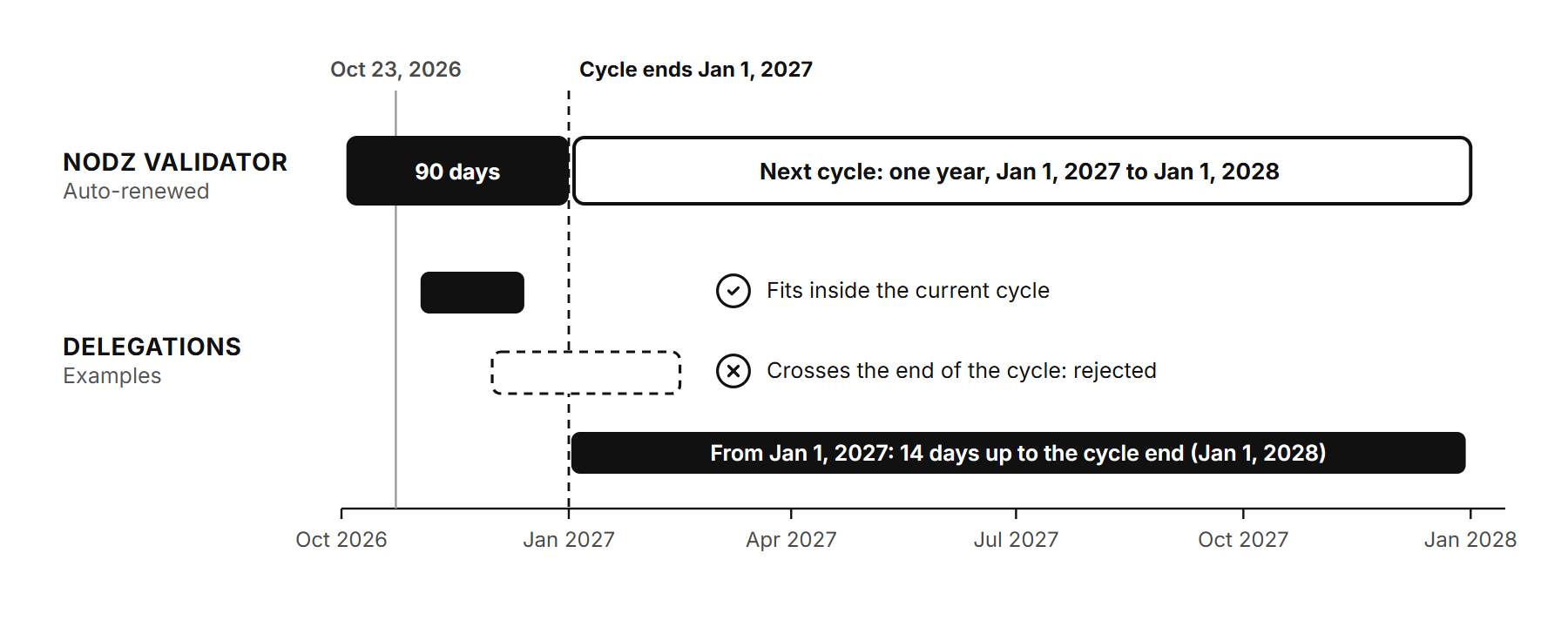
Our validator's cycles, as recorded on the P-Chain on October 23, 2026. A delegation that crosses the end of the current cycle is rejected by the protocol.
The non-custodial model works exactly as described above. Your AVAX stays locked on the P-Chain under your own key, we never hold the key that controls your funds, and your stake and rewards come back to your address automatically when your delegation ends.
- NodeID: NodeID-HVx3AVYPCCSqftjWK9CgaPLyE7DSeYAiF
- Delegation fee: 2%, the protocol minimum
- Cycles: auto-renewed; the next one runs for one year from January 1, 2027
- Delegation duration: your choice, from 14 days up to the end of the current cycle
Sources
- Team Rocket, Yin, Sekniqi, van Renesse and Sirer, Scalable and Probabilistic Leaderless BFT Consensus through Metastability
- Avalanche docs: Snowman consensus, How to stake, Rewards formula, Transaction fees, Interchain Messaging
- Avalanche Community Proposals: ACP-77, ACP-236, ACP-267, ACP-273, ACP-285
- AvalancheGo v1.15.0 release notes (Helicon)
- P-Chain API (
platform.getCurrentValidators,platform.getCurrentSupply), queried on October 23, 2026 - DefiLlama: Avalanche and CoinGecko: AVAX, accessed October 23, 2026
- Nansen: Avalanche Q2 2026 Report
- Charles Schwab: Crypto Key Debates: Chainlink and Avalanche
- The Block: VanEck's Avalanche ETF and Galaxy's tokenized CLO
#Engineering